
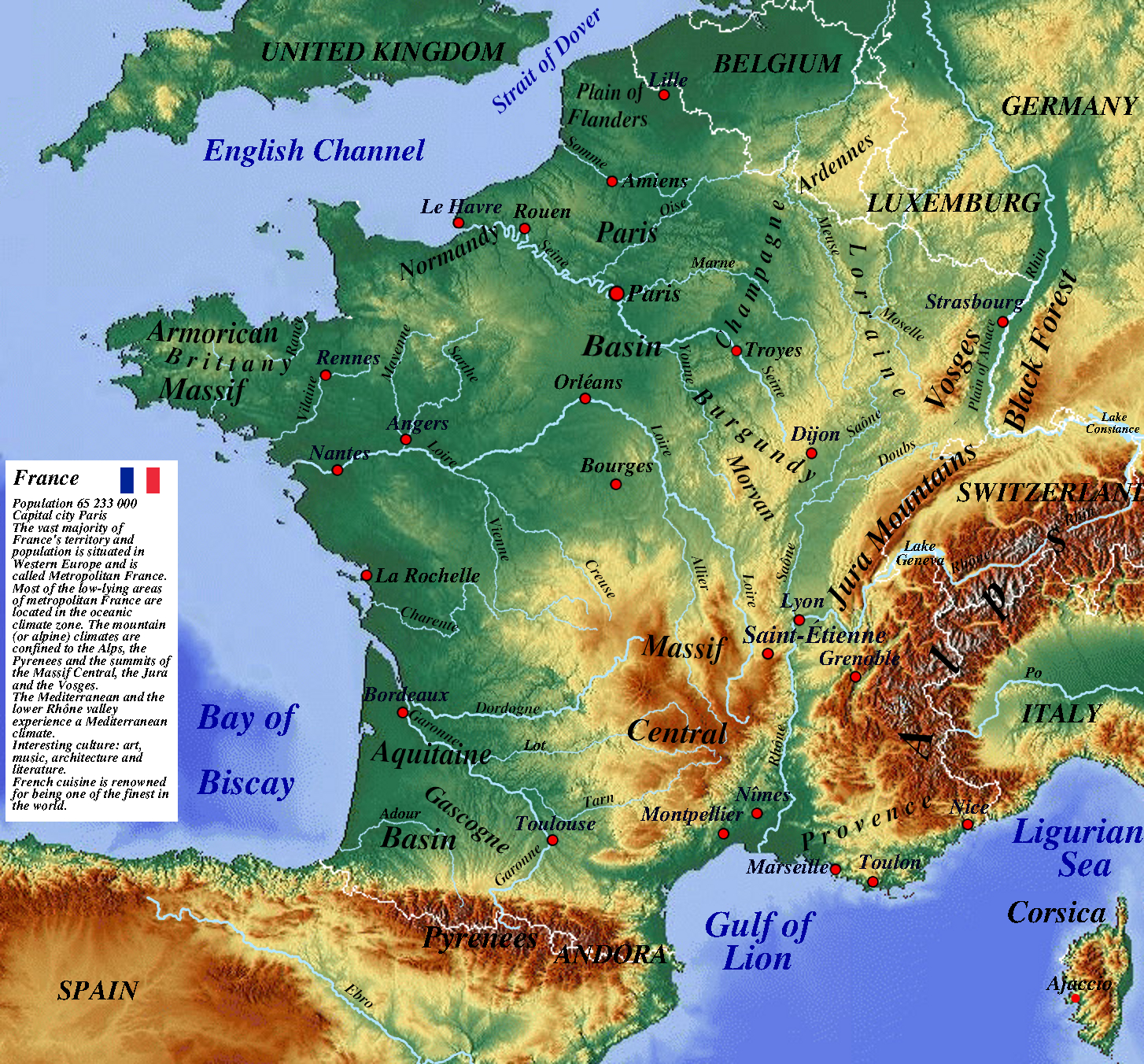
Physical Map of France
The vast majority of France's territory and population is situated in Western Europe and is called Metropolitan France. Most of the low-lying areas of metropolitan France are located in the oceanic climate zone. The mountain (or alpine) climates are confined to the Alps, the Pyrenees and the summits of the Massif Central, the Jura and the Vosges. The Mediterranean and the lower Rhône valley experience a Mediterranean climate.
France is the world's third largest exporter of agricultural products. The country exports wheat, poultry, dairy products, beef and pork, as well as processed foods. French champagne and Bordeaux wines are globally famous. Additionally, the food, chemical, and automotive industries have the greatest importance for the French economy.
Among the largest economies in the world, France is distinguished by one of the lowest levels of poverty, the smallest income inequality, and a high-level system of social services (health care, education system, pension system) and public services (transport, security).
France - Statistical Data (UN Data 2018)
Geography & Population
- Population: 65,233,000
- Surface Area: 551,500 km²
- Pop. Density: 119.1 / km²
- Urban Population: 80.4%
- Forested Area: 31% of land
Economy & GDP
- GDP (Gross Domestic Product): $2,465,454,000,000
- GDP Growth Rate (Annual): 1.2%
- GDP Per Capita: $36,826
- International Trade (Exports): $526,267,000,000
- International Trade (Imports): $617,386,000,000
Employment by Sector
- Services Sector: 76.9%
- Industry Sector: 20.3%
- Agriculture Sector: 2.8%