
Beech (Fagus) is a genus of deciduous trees in the family Fagaceae, native to temperate Europe, Asia, and North America.
Recent classifications recognize 10 to 13 species.
Beeches are deciduous trees that can grow up to 40 meters tall. The bark is gray and smooth, only rarely showing rough fissure formations in old age.
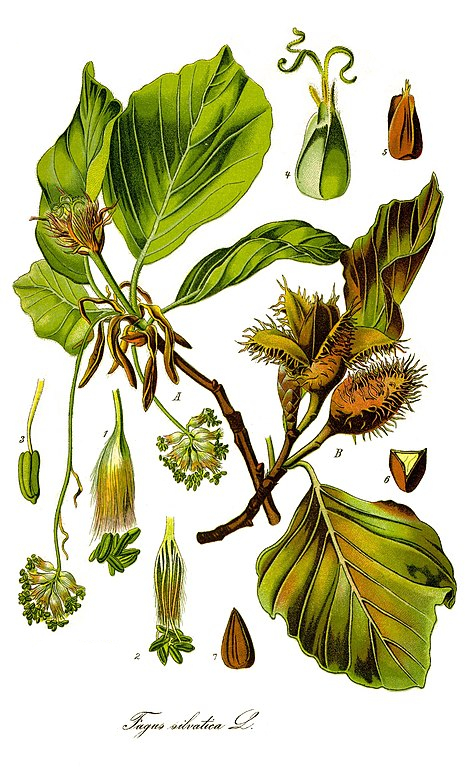
Fagus sylvatica, the European beech or common beech
The leaf blade is glossy green, entire, slightly sinuously toothed, wavy, or finely toothed.
The fruits are triangular, 1 to 1.5 centimeters long, shiny chestnut-brown nuts known as beechnuts. They sit in pairs, rarely in threes, inside a woody, soft-spiky, four-lobed fruit cup (cupule). Beechnuts ripen in autumn.
It is a shade-tolerant species in drier climates and light-demanding in humid climates, most often inhabiting cool and mature forests. In temperate, cool zones, a young beech tree capable of enduring shade can significantly slow its growth—unlike pioneer species such as birch, sycamore maple, or ash. It survives for long periods under a dense canopy while waiting for a light gap to open.
In shade, it grows slightly slower than maple or ash, but compensates with a leaf architecture and crown structure that maximize light capture over the tree's entire height. It also features a larger total leaf surface area than most other temperate hardwood species.
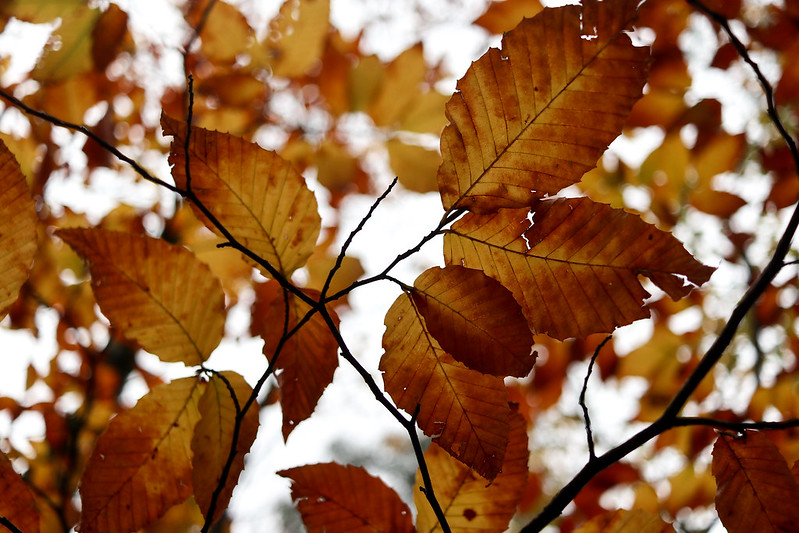
The European beech (Fagus sylvatica) is the most commonly cultivated species.
The wood of Fagus sylvatica yields a utility timber that is tough but dimensionally unstable. It is widely used for furniture framing, cabinet construction, flooring, plywood, and household items like kitchenware, though rarely as a decorative wood. The timber can also be utilized in building chalets, houses, and log cabins.
Disclaimer: This article uses material from the Wikipedia articles Beech and Fagus sylvatica (contributors), which are released under the Creative Commons Attribution-ShareAlike 3.0 Unported License.